
Steep and Ridge Lot Clearing in Roane County, TN
Steep lot clearing in Roane County is a different job from clearing flat ground. The Walden Ridge escarpment, the eastern edge of the Cumberland Plateau, stands above much of the county, and below it the land folds into long ridges and valleys with thin, rocky soil on the ridge flanks. On a hillside lot, how much gets cleared, in what order, and what holds the ground afterward matter as much as the clearing itself. Here's what the terrain is made of, how careful work is staged, what to do about the driveway, which rules come into play, and how slope shows up in the price.
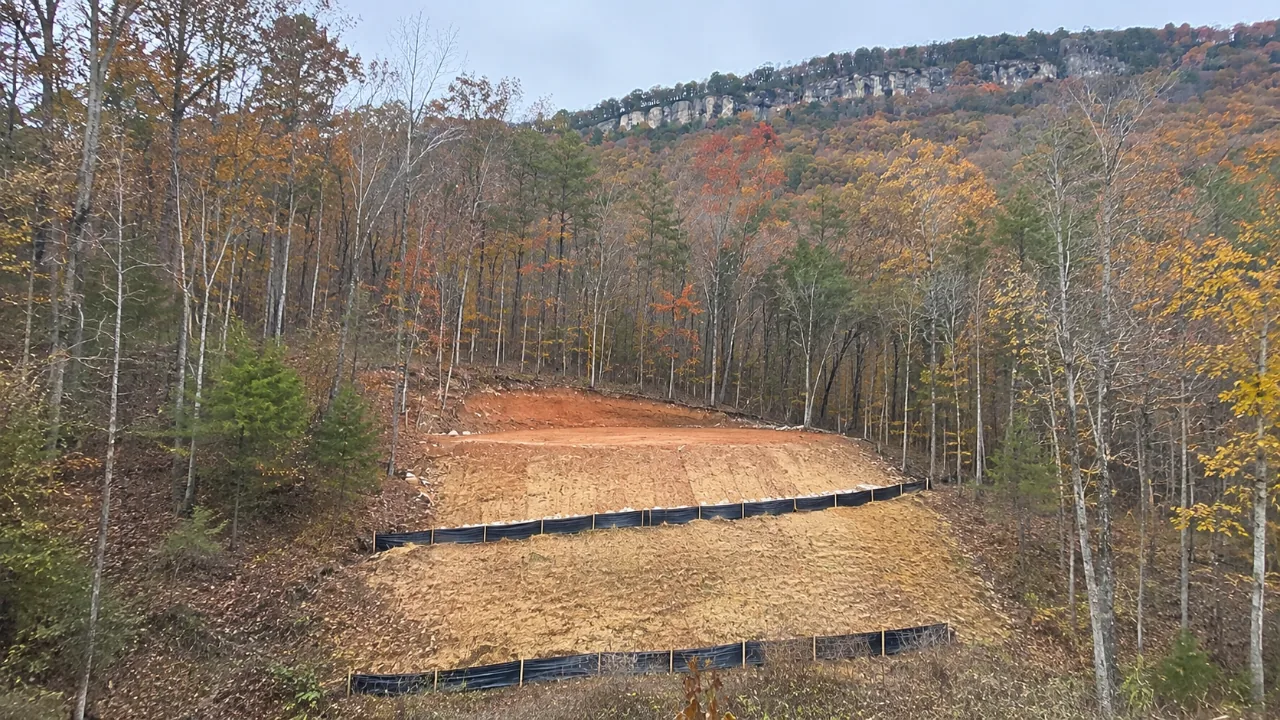
The ground you're working on
Roane County sits on the boundary between the Ridge-and-Valley and the Cumberland Plateau, and the Walden Ridge escarpment can be seen from much of the county. The Tennessee Encyclopedia describes Walden Ridge as running from Cumberland and Roane counties south to the Tennessee River gorge, "generally rising to 2,000 feet in elevation," and forming the eastern edge of the plateau.
The federal ecoregion map of Tennessee describes the main kinds of slope you'll meet here:
- Dissected ridges and knobs, tied in places to shale and siltstone with sandstone beds. Chestnut oak and pine forests are typical higher up, with white oak, tulip poplar, and mixed forest on the lower slopes and in the draws.
- Sandstone ridges, where soils are "typically stony, sandy, and of low fertility."
- Shale valleys, where steeper slopes have "reverted to brush and forested land" and small farms and rural homes divide up the land.
- The plateau escarpment itself, made of limestone, sandstone, shale, and siltstone, with mixed oak and chestnut oak on the upper slopes.
The soil on those slopes is often more rock than dirt. NRCS describes the Bodine soils of sharply dissected uplands as gravelly silt loams whose subsoil averages 35 to 80 percent chert fragments, on slopes of 5 to 70 percent, with chestnut oak, eastern redcedar, and Virginia pine among the trees where they're wooded. Fullerton soils, found on ridges, have red clay subsoil with chert gravel and range from 2 to 70 percent slope. Chert and shale wear a mulcher's teeth and an excavator's bucket, and once the leaf litter and roots are gone, a bare slope of either can wash in one hard rain.
Clear in stages, top to bottom
On a hillside, the safest plan exposes as little bare ground as possible at any one time:
- Put the erosion controls in first. Silt fence below the work, and a second row lower down on a long slope, before any soil is opened.
- Clear the bench, not the hill. Take out the house footprint, a working margin, and the drive. Leave the rest wooded or just thin the understory.
- Keep roots in the banks. Where nothing will be built, cut trees at the stump or mulch the brush and leave the root systems holding the slope.
- Cover bare soil the same week. Straw, erosion matting on the steepest cuts, and seed. Red clay and broken shale don't heal on their own fast enough.
- Stop when it's wet. Tracked machines on a saturated slope rut it, slide, and leave channels for the next storm.
Operators approach steep ground in different ways, from a tracked mulcher working across the slope to an excavator reaching downhill from a bench, to saw work where no machine should go. Ask the contractor how they plan to work your slope and where the machine will travel.
The driveway is the biggest cut
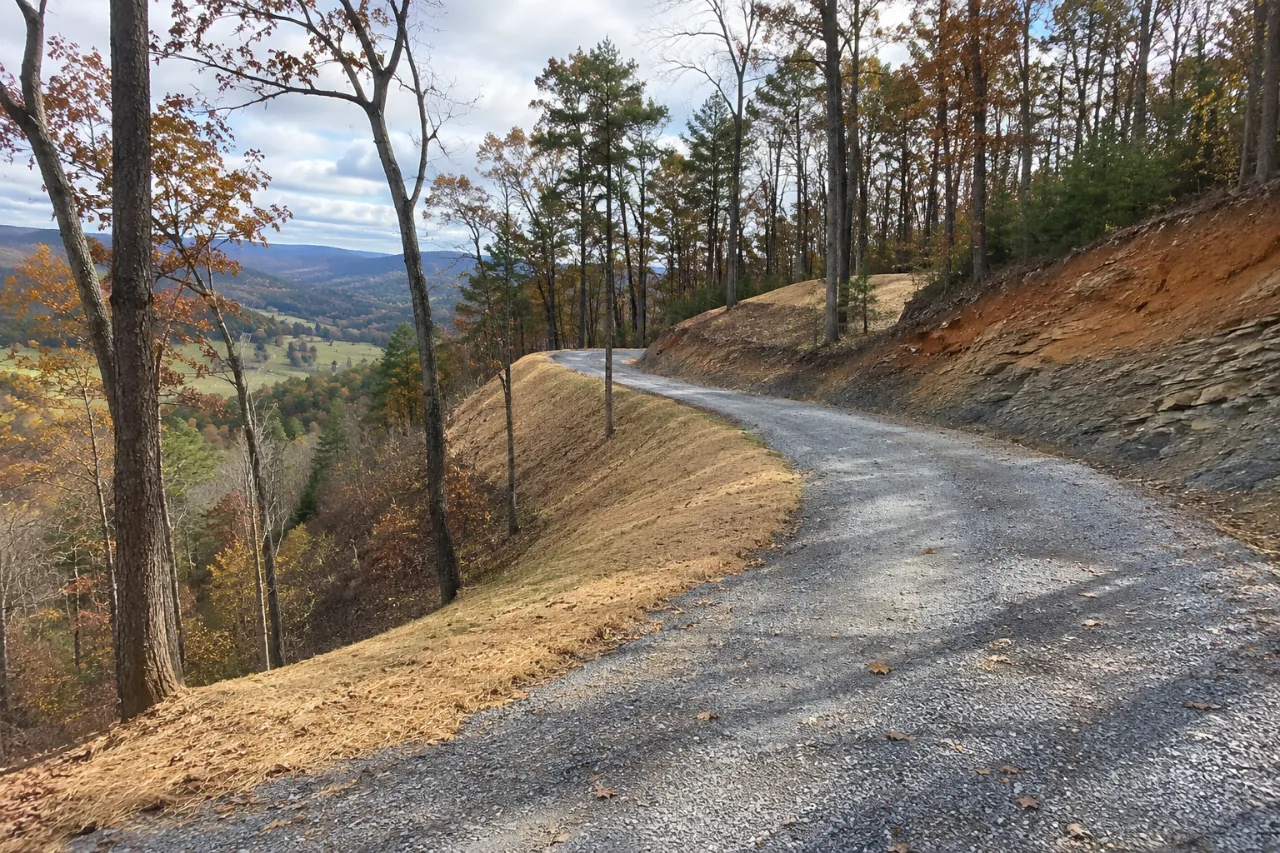
On a ridge lot, the drive usually disturbs more ground than the house. A drive that climbs straight up the fall line turns into a ditch in heavy rain; one that angles or switches back across the slope is easier to drive and easier to keep. Roane County's subdivision regulations cap new subdivision street grades at 14 percent, which gives a sense of what the county considers too steep for a road, though a private drive on an existing lot is a separate question. Plan for culverts where the drive crosses a draw, and a stabilized, seeded bank on the downhill side. Where the drive meets a road, ask whoever maintains the road what it requires; inside Harriman, the city's zoning ordinance has its building official issue driveway permits.
Rules that come into play
- The state's one-acre line. Construction that disturbs one acre or more needs coverage under TDEC's construction stormwater permit, with a stormwater plan. Hillside lots reach an acre faster than you'd think once the drive is counted.
- Subdividing. Roane County's subdivision regulations list steep slopes, along with flooding, bad drainage, and soils, as conditions that can make land unsuitable for subdividing unless the developer comes up with adequate ways to deal with them.
- Your lot. Before clearing a hillside lot, ask Roane County Building Codes and Zoning, 865-717-4230, whether anything beyond the building permit applies. Inside Kingston, Harriman, or Rockwood, ask the city.
- Streams in the draws. A hollow may carry a wet-weather branch at the bottom. Changing a stream channel or bank needs a TDEC Aquatic Resource Alteration Permit; the Knoxville field office is (865) 594-6035.
- Buried lines. Grading and digging need a Tennessee 811 ticket three to ten working days ahead.
The permits guide has the links and the rest of the phone numbers.
How slope shows up in the price
A slope slows everything: the machine moves more carefully, more of the work is done by hand, and there's more erosion control to buy and install. National guides note it too; HomeAdvisor's 2025 stump grinding guide, for instance, lists terrain surcharges of up to $50 an hour. When you compare quotes on a hillside lot, check that each one includes silt fence, straw or matting, and seed, and says how the drive will be shaped and drained. A low price that leaves those out can cost more by spring. See the cost guide for published per-acre figures.
Steep lot questions
Can a mulcher work a slope this steep?
That's for the operator to judge on site. Some slopes are machine work, some need a bench cut first, and some are saw work only. A good walk-through ends with a clear answer on where the machine will and won't go.
Should the whole hillside be cleared for a view?
Usually not. Thinning the understory and limbing up a few trees opens a lot of view while leaving the roots that hold the slope. On a lake lot, cutting on TVA land needs TVA's approval; see lake lot clearing.
What time of year is best for hillside clearing?
A dry stretch, with enough growing season left to get seed established on bare soil. Ask the contractor what they'd do to protect the slope if the job runs into a wet spell.
How this site can help
Send a request or call, and describe the slope as well as you can: where the house and drive would go, and whether there's a branch in the hollow. Your request goes to one independent contractor serving your part of the county, who will look at the ground and write up a quote. You decide from there. The referral is free.
Ready to have someone look at the property?
Call, or send a few details online. The referral costs you nothing.