
Forestry Mulching in Roane County, TN
Forestry mulching in Roane County is the go-to method when you want brush and small trees gone but the ground left covered and the roots left in it. One tracked machine with a spinning, toothed drum grinds briars, saplings, and thickets of young pine into a layer of chips where they stand. It fits wooded home sites, overgrown old fields, trails, and fence rows across the ridges and valleys from Rockwood to Ten Mile. This guide covers how it works, where it fits, where it doesn't, what the chert in local soils does to it, what grows back, published prices, and the permit questions to ask.
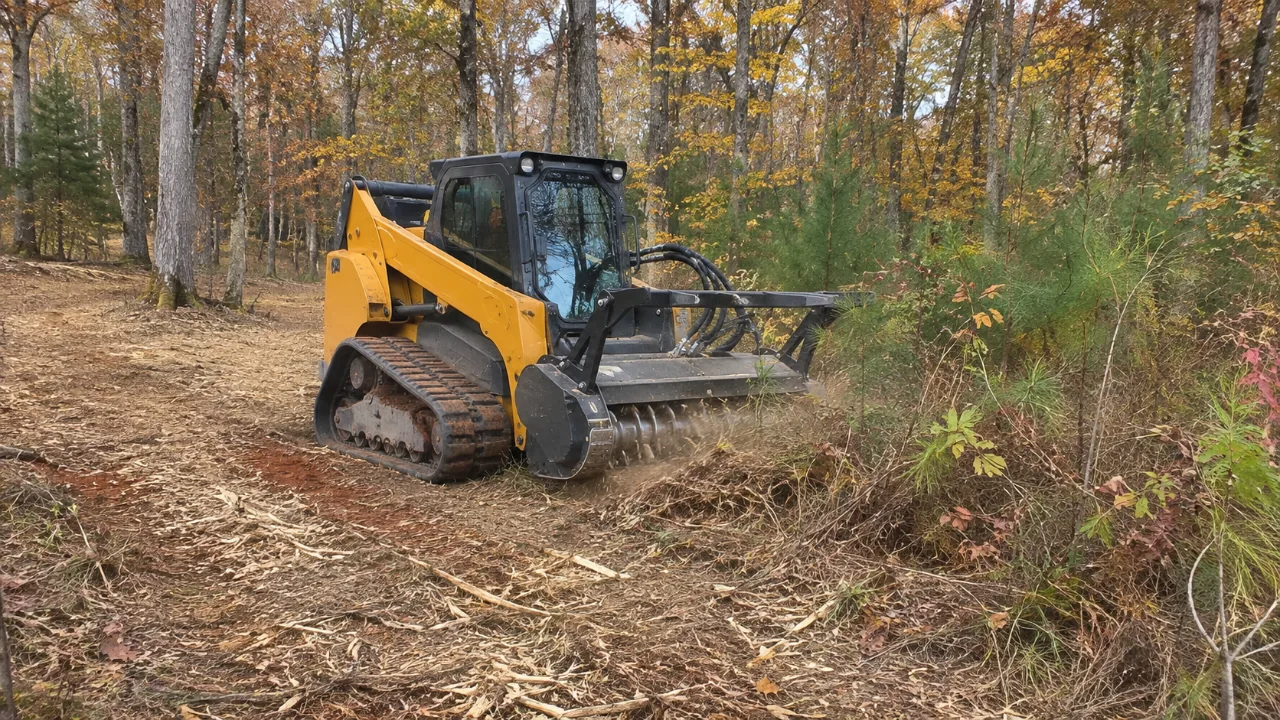
How mulching works
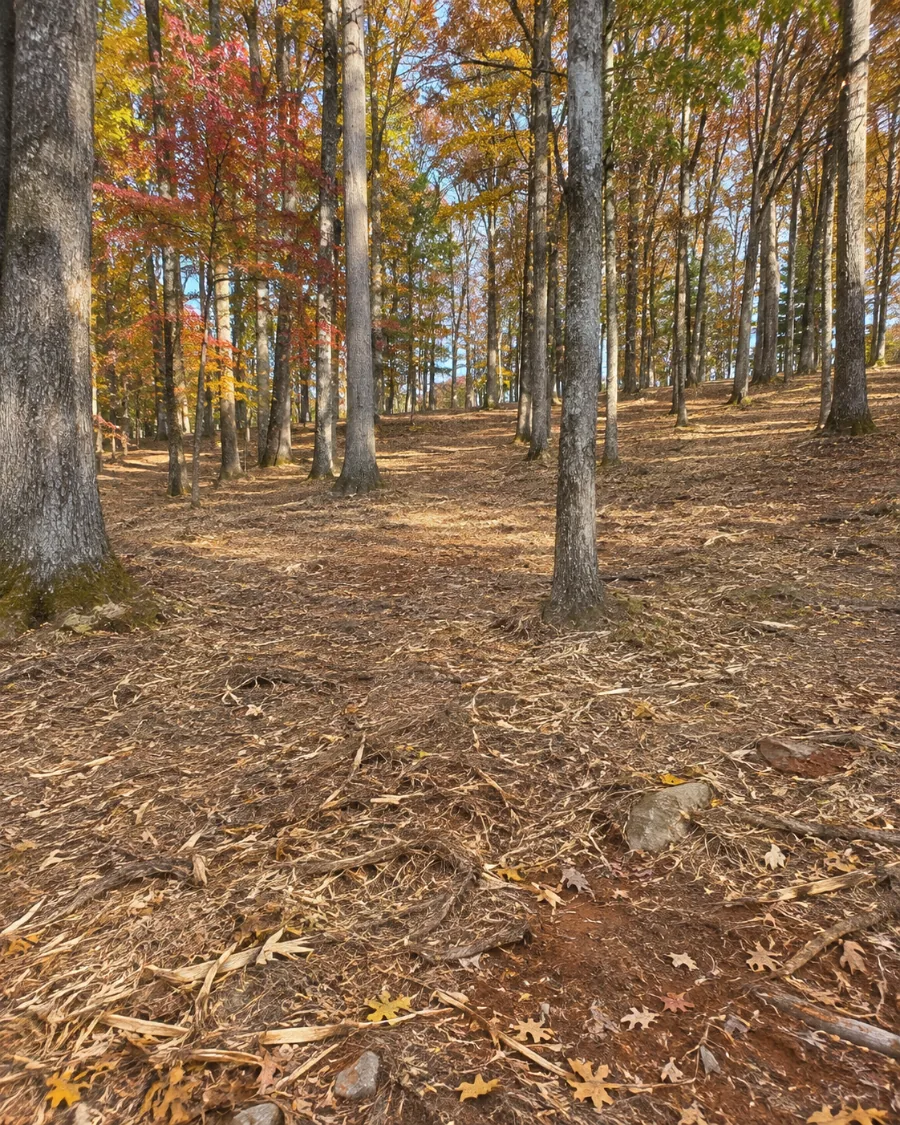
The machine is usually a compact track loader or a purpose-built carrier with a mulching head on the front. The operator lowers the drum onto brush or a small tree and grinds it down to the ground, then moves on. There's no cutting, dragging, and piling, so there's nothing left to burn or haul away. What remains is a layer of shredded wood over the soil, with stumps ground low and roots still in the ground.
That last part is the main reason to choose it here. On a slope of red cherty clay or broken shale, the roots and the chip layer are what keep rain from carrying the soil off. Mulching also leaves the trees you want to keep: the operator works around them, and you can flag keepers before the machine arrives.
Where it fits
- Understory under hardwoods. Clearing the brush, briars, and saplings under oaks, hickories, and tulip poplars on a wooded home site, so you can see and walk through the woods.
- Pine and cedar thickets. Young Virginia pine and eastern redcedar can crowd old fields and woods edges; NRCS lists both among the trees on the cherty upland soils of this region.
- Old fields gone to brush. Taking a grown-up pasture or hayfield back to open ground, ready for mowing.
- Trails, lanes, and fence rows. A path through the woods, a firebreak, or a fence row you want opened up.
- Above a lake line. Thinning on your own land above TVA shoreland, with the roots left in the bank.
Where it falls short
- Under a house, slab, drive, or septic field. Roots and a chip layer aren't a building base. Those spots need stumps dug out and the soil exposed; see house-site clearing.
- Big trees. Large hardwoods are usually felled with a saw and handled separately, as logs or firewood, rather than ground whole.
- Wet ground. Tracks on saturated clay leave ruts that channel water. Wait for a dry spell.
- Slopes beyond the machine. Some ground is too steep for any carrier; the steep lot guide covers the options.
- TVA-owned shoreland. Mulching there is vegetation disturbance, which TVA says always needs its written approval first. The federal rule also says the forest floor on that land is to be left undisturbed outside what the approved plan allows.
Chert, shale, and the mulching head
The teeth on a mulching drum are made to cut wood, and rock dulls or breaks them. Many of the upland soils in this part of Tennessee are loaded with chert. NRCS's description of Bodine soils, found on sharply dissected uplands across the region, puts 20 percent chert fragments in the surface layer and 35 to 80 percent in the subsoil; Fullerton soils on the ridges carry chert gravel through a red clay subsoil. The ridges and the plateau escarpment add layers of shale, siltstone, and sandstone. An operator working that ground has to keep the head just above the soil, which slows the work, and teeth get replaced more often. That's one reason two mulching quotes on different-looking land can be far apart.
What comes back
Mulching takes off the top growth. It doesn't kill roots, and several of the worst plants on local land come back from them. UT Extension's 2024 invasive species series says Chinese privet will "resprout from roots and stumps," that autumn olive "resprouts strongly after cutting or burning," and that kudzu's roots fuel "vigorous regrowth" when the vines are mowed or grazed.
So plan the second season along with the first. Mowing the regrowth keeps an opened area open, and where privet, bush honeysuckle, or autumn olive are thick, UT Extension recommends herbicide treatments such as cut-stump, basal bark, or foliar sprays, timed to the plant. Ask whether follow-up is part of the quote or a separate visit. The brush and fence line guide goes plant by plant.
Published mulching prices
These are national figures, checked in October 2026; neither guide gives a Tennessee or Roane County price.
- HomeAdvisor's forestry mulching guide (checked October 2026): most homeowners pay $400 to $1,500 an acre, with $500 an acre as the national average. Hourly: $125 to $200 for underbrush and small trees, $150 to $300 with grading, $200 to $400 for heavy, dense brush.
- Angi's forestry mulching guide (labeled 2024 data): $400 to $1,500 an acre, about $800 an acre on average, or $125 to $400 an hour for residential work.
- HomeAdvisor lists skid steer rental with a mulching attachment at about $1,200 to $3,000 a day, if you're weighing doing it yourself.
Dense pine, rocky ground, steep slopes, and a long haul to the site push a job toward the top of those ranges. The contractor's written quote, after they've seen the land, is the price that matters. More in the cost guide.
Permit questions to ask
- Is it part of construction? If the mulching is part of building a house or other development and the disturbed area reaches an acre, TDEC's construction stormwater permit applies.
- Is it on farmland? TDEC's ARAP page notes that some conservation practices on agricultural land may still need stormwater or ARAP coverage. The Knoxville field office, (865) 594-6035, can tell you.
- Is there a creek? Keep the machine out of the channel. Building a crossing or reshaping a bank is the kind of work TDEC's Aquatic Resource Alteration Permit covers.
- Is it near the lake? Anything on TVA-owned shoreland needs TVA's approval first; see lake lot clearing.
Mulching questions
How big a tree can a mulcher take?
It depends on the machine and the head, so ask the contractor. Bigger trees are often felled and bucked up instead, and you can keep the wood.
Does the mulch need to be hauled off?
Normally it stays and breaks down where it lies, covering the soil while it does. Where you want grass right away, ask about thinner spreading or raking it back.
Is mulching cheaper than clearing with an excavator?
For brush and small trees, generally yes, because nothing is dug, piled, or hauled. Compare the per-acre mulching figures above with the dense-woods clearing figures in the cost guide.
How this site can help
Let us know roughly how many acres, what's growing there, and how steep it is. One independent contractor who mulches in your area will get your request, look at the ground, and give you a written price. You decide whether to go ahead, and the referral costs nothing.
Ready to have someone look at the property?
Call, or send a few details online. The referral costs you nothing.