
Stump Grinding in Roane County, TN
Stump grinding in Roane County might mean one old oak stump in a Kingston side yard or forty pine and poplar stumps left behind on a new house site. Either way the first decision is the same: grind the stump down below the surface, or dig the whole thing out. This page explains which one fits where, what chert and rock in the soil do to a grinder, which stumps sprout again, why a Tennessee 811 ticket comes first, where not to grind, and what published prices look like worked out for one stump and for several.
Grind it or dig it out?
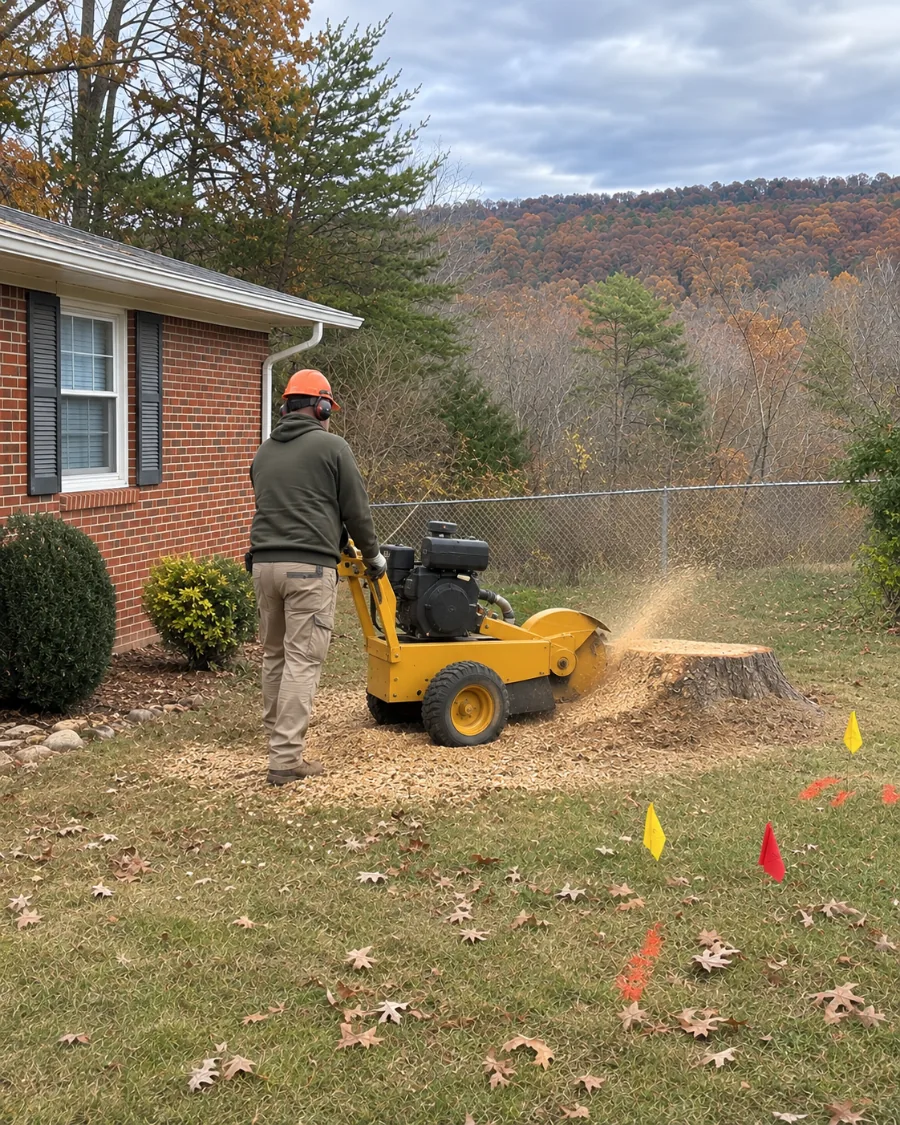
Grinding chews the stump and the top of the root flare into chips, usually to a few inches below the ground, and leaves the deeper roots to rot in place. It's quick, it barely disturbs the yard, and it's the right choice where you'll mow, plant grass, or put in a flower bed.
Digging out means an excavator pulls the stump and its main roots, leaving a hole to backfill and compact. That's what you want under a footing, a slab, a driveway, a shop, or anywhere soil has to be firm and settle evenly. On a house site, the usual plan is both: dig out what's under the building footprint and drive, grind or leave the rest.
Grinding leaves a pile of chips mixed with soil. Some people rake it back into the hole and top it with soil and seed; some have it hauled. Either way, the spot tends to sink a little as the buried roots rot, so plan to add soil later.
Rock, chert, and the grinder wheel
A stump grinder's teeth are made for wood. Rock dulls or breaks them, and around here a lot of ground is full of it. NRCS describes the Fullerton soils of the region's ridges as having 20 to 30 percent chert gravel in a red clay subsoil, and the Bodine soils of steep uplands as averaging 35 to 80 percent chert fragments below the surface. A tree that grew up through that has stones wrapped in its root flare. Ask the contractor how they handle a stump with rock in it, whether rock changes the price, and how far below grade they'll grind.
Stumps that come back
Some stumps stay dead once the tree is cut. Others don't. UT Extension's 2024 fact sheets say Chinese privet will "resprout from roots and stumps," and that autumn olive "resprouts strongly after cutting or burning." Grinding the stump of a shrub like that leaves the roots alive to send up new shoots. For those plants UT recommends cut-stump treatment, applying herbicide to the freshly cut stump to kill the root system, and follow-up on anything that sprouts. If a fence row or thicket is part of the job, the brush and fence line guide covers the treatment plan.
Call 811 before the grinder starts
Water lines, gas service, buried electric, and phone and cable lines often run right past old yard trees. The Tennessee Public Utility Commission's damage prevention FAQ defines excavation as moving or removing earth with mechanized equipment, among other means, and lists digging and grading among the examples. Notice is due at least three, and not more than ten, working days ahead, marking requests are free, and damage penalties can reach $15,000 per incident. Grinding below grade moves earth with a machine, so have whoever is doing the work get a ticket through 811 first. The ticket goes to the utilities serving the area, so also point out any line you put in yourself, such as one running to a well, shop, or barn.
Places to think twice
- Over a septic field or tank. Know where the tank, lines, and drain field are before any grinder or excavator gets near them. TDEC's Knoxville Environmental Field Office, (865) 594-6035, handles septic questions for Roane and Loudon counties.
- On TVA-owned shoreland. The federal rule for that land says the forest floor is to be left undisturbed outside what TVA approves, and TVA says any vegetation work there needs its written approval. See lake lot clearing.
- On a steep bank. A stump's roots may be what's holding the bank. Cutting it flush and leaving the roots is sometimes the better choice; the steep lot guide explains.
- Next to a foundation or wall. Ask how close the machine can safely get and what they do about roots under the structure.
Published stump grinding prices
HomeAdvisor's 2025 stump grinding guide (checked October 2026) gives these national figures:
- An average of $250 per stump, in a normal range of $120 to $500.
- $2 to $5 per inch of diameter.
- A minimum of $100 to $150 for a single stump at many companies.
- Extra for difficult terrain (up to $50 an hour), root removal ($100 to $200 an hour), and debris removal (about $50 an hour).
One stump. An 18-inch stump at $2 to $5 an inch works out to $36 to $90, so the $100 to $150 minimum would probably set the price.
Five stumps. Five stumps averaging 20 inches add up to 100 inches, or $200 to $500 at those per-inch rates, before any rock, slope, or cleanup charges.
Those are national figures worked through as examples, not local prices. Measure each stump across its widest point at ground level, send the count and sizes with your request, and let the contractor's written quote set the real number. The cost guide has clearing and mulching figures too.
Stump questions
How deep will a contractor grind?
It varies by machine and by what's going on the spot afterward. Say what you plan, such as lawn, a garden bed, or a fence post, and get the depth written into the quote.
Can the grinder get into a fenced back yard?
Many small grinders fit through a standard gate, and larger ones don't. Measure the gate opening and mention it, along with any steps or slopes on the way in.
Is a stump on a lake lot handled differently?
On your own land, no. On TVA-owned shoreland, nothing should be ground or pulled without TVA's written approval.
Why do two stump quotes differ so much?
Often they cover different work. One grinds a few inches down and leaves the chips; another grinds deeper, removes surface roots, and cleans up. Compare what each includes.
How this site can help
Send the number of stumps, their rough sizes, and how a machine gets to them. One independent contractor serving your area will get the request, look at the stumps, and write up a price. You decide from there. The referral is free.
Ready to have someone look at the property?
Call, or send a few details online. The referral costs you nothing.